The Manuscript, Memorabilia & Collectibles Auction
Featuring personal belongings of Dodger Great Junior Gilliam
December 1, 2001
(If you have a problem viewing enlarged photos, your browser may be blocking pop-up windows. Check with your IT consultant.)
Antiquities
Near East
Lot 677


A Handsome Gangetic Valley
Harpoon of Medium Size. Ancient India, Uttar Pradesh, c. 1500-1200 BC.
Harpoon of copper, with reinforced triangular blade of medium width on
thick cylindrical shaft -- this tapering towards a narrower flattened base. The
ends of the heavy blade terminate in longish barbs, with additional
backwards-facing barbs symmetrically arranged along the shaft. Piercing at rear
most barb for attaching head to handle. A very well preserved example of these
scarce tools or weapons, with very fine two-tone green patina. Length: 12-7/8".
Estimated Value $400-UP.
Ex Gangetic "Hoard," sold Sotheby's NY,
9-20/21-85, lot 334. Small hoards of copper objects of this type have been
found for the most part in Uttar Pradesh, with additional finds from sites in
Bihar and Madhya Pradesh, plus finds to the west in Pakistan, e.g. Shalozan,
along with findspots further south in Bhagrapir, in Orissa, and at Kallur. This
and the following two lots are from the Sotheby group cited. According to
Agrawal, harpoons of this type "could have been used for killing fish or big
game, as shown in a rock-shelter in Mirzapur"; for type and discussion, cf. pp.
204-207.
Lot 678
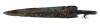
A Large and Imposing
Gangetic Valley "Antenna Sword." Ancient India, Uttar Pradesh, c.
1500-1200 BC. Sword of cast and wrought copper. The narrow triangular
blade having a sharply carinated reinforcing central rib and thickend tip,
strengthened for piercing. The blade ends terminating in rounded barbs. The
sword's tang of flattened rectangular section, a thick sliver of which has been
peeled back to form a very sharp, rounded barb. It is this feature which earns
this class of weapon its nickname. A few minor dents along the blade, otherwise
with good green patina under cleanable encrustations. Pleasing example, and not
often seen. Length: 19-1/8".
Estimated Value $350-UP.
Ex Gangetic
"Hoard," sold Sotheby's NY, 9-20/21-85, lot 334.
Lot 679

Lot of Two Bronze Blades --
A Robust Persian Spearhead, and a Slim Indian Harpoon. Luristan, N.W.
Iran, & Ancient India, Uttar Pradesh, c. 1500-1200 BC. The two an
interesting contrast of blade types. The Indian harpoon of the type seen in the
earlier lot, but slimmer and smaller, and comprised of a multi-barbed blade
only. This with six paired, symmetrical barbs (one missing where blade was
pierced for attaching cord). Behind these, two thick, triangular swellings, one
with an additional piercing to take a second cord. The Persian point, c.
1000-800 BC., is comprised of a narrow lanceolate blade, with wide, rounded
midrib, and set on a broad and very thick, squarish shaft with flaring
protrusions and sharply tapered tang. Blade edges well sharpened. The Indian
piece a little bent, but shows overall fairly modest use; with pleasing medium
to tan green patina. The Persian Very Fine, with moderate signs of use, and
with deep green to dark brown patina. Length of harpoon: 9-3/4". Length of
spear point: 14-1/2"; comes with black metal stand. Lot of 2 pieces.
Estimated Value $300-UP.
Harpoon, Ex Gangetic "Hoard," sold
Sotheby's NY, 9-20/21-85, lot 334. Good dealer lot.
Lot 680

An Important Dagger, with
Royal Inscription. Western Iran, Luristan, c. 1200-1000 BC. Bronze dagger,
cast and wrought, of usual form. The blade somewhat lanceolate, with heavy
midrib, and long, unworked "throat." The tapered handled, with crescentic
pommel, and channeled to accept inlays. These would have been in bone, ivory,
or stone, and were held in place by the folded over flaps at the handle's base
(only one extant). Inscribed on each side at blade's throat, are two registers
of cuneiform inscription. Also, on one side a bisected arch, and an outlined
cross on the other. This dagger a well used tool. The blade shows repeated
sharpening and some nicks, while two of the handle flaps have worn thin until
they fell off. Dagger with good dark green and black patina. Length: 12". Very
rare!
Estimated Value $2,000-2,500.
Typically, inscribed Luristan
daggers would bear the name of the king who would have given the weapon as a
gift to a soldier or a member of his private bodyguard. The cross seen on this
blade is ethnic emblem typical of Kassite inscriptions and art -- perhaps
indicating this blade saw its gifting further west, among the Kassite kingdoms.
Go to Next Catalog Page