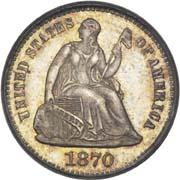
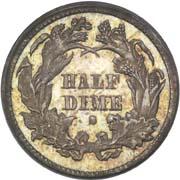
1870-S. PCGS graded MS-63- UNIQUE!. A lovely coin for the grade, the fields are slightly prooflike, while the devices glow with satiny luster. All is toned an antique gold color which is very original in appearance. There are some minor surface marks, accounting for the grade, which were acquired while the coin remained numismatically undiscovered for over a century. Currently in PCGS holder #2575130. Color photo.
The San Francisco Mint had outgrown its quarters and a new building was begun in 1870. When the cornerstone was laid, coiner J. B. Harmstead struck a few pieces for inclusion there. One of these is reported to be an 1870-S $3 gold piece, and possibly other coins from 1870. Apparently, Harmstead struck an additional $3 piece for himself and mounted it on his watch fob or the like. Later, when Thomas L. Elder auctioned the collection of William H. Woodin in March 1911, an 1870-S $3 piece was offered along with a piece of paper reading "This is a duplicate of the coin struck for the cornerstone of the San Francisco Mint and the only one in existence. J. B. Harmstead." The coin had been repaired to remove a loop from the top, but still managed to bring an astounding $687,500 when it sold in the Eliasberg gold sale in 1982.
It is very likely that this 1870-S half dime has a similar story. It may have been struck by J. B. Harmstead, kept in his personal collection as a coin whose mate resides in the cornerstone of the new Mint. Somehow, its value was unrecognized and it passed into normal numismatic channels. Eventually, it found its way into the limelight, being plucked from a box of coins in 1978 and made its way to RARCOA, in time for display at the 1978 ANA show in Houston.
How to value such a coin? After a thorough and exhaustive authentication process, the coin was declared genuine in every respect, and was so far as known, unique. No 1870-S half dimes were reported struck at San Francisco in 1870, but for that matter, neither were any 1870-S $3 pieces (also unique) or even the 1870-S silver dollars, of which there are approximately 15 known. The owners of Rarcoa, Ed Milas and Dennis Forgue decided that the value of this 1870-S half dime would be determined by the sale of the Garrett 1804 silver dollar in March of 1980. Milas and Forgue determined that they would add $25,000 to the selling price of the Garrett 1804 dollar, whatever that would be, and offer the 1870-S half dime for that price. The Garrett 1804 dollar broke all previous auction records, selling for a stunning $400,000. Thus the 1870-S half dime was offered for $425,000, and promptly sold to John Abbott, a well known Michigan numismatist.
After intense publicity of the sale price of the 1870-S half dime, no others have turned up, and the coin remains unique a full 22 years after its initial discovery.
Obviously, someone was striking just a few coins of the various denominations of 1870-S. It was most likely J. B. Harmstead, as the 1870-S $3 coin was traced to him as noted above. Perhaps he made a few other samples that year, just to "test" the dies or some similar excuse was employed. Whatever the case, we have today a major rarity, comparable to the 1870-S $3 piece or the 1873-CC dime without arrows, or the 1849 double eagle, each of which is thought to be unique. Other comparable rarities are the 1822 half eagle, with 3 known, 2 of which are in the Smithsonian, or the 1913 Liberty Nickel, with 5 known.
No collection of United States coins can be complete without this piece. Therefore, if you are absolutely serious about undertaking the ultimate Guide Book collection, then this coin must be acquired. Discovered in 1978, Louis Eliasberg never obtained it, as he passed away in 1976. While other rarities proclaim their value, this unique 1870-S half dime lay hidden to the numismatic world for over 100 years, only to be discovered and appreciated long after the 1913 nickels and 1804 dollars had already made a big name for themselves. As Dave Bowers said in 1985 when this coin was auctioned "Whatever this coin sells for--$275,000, $500,000, $687,500--or whatever happens once it crosses the auction block, the new owner will have the satisfaction that so far as is known, $1,000,000, $10,000,000 or no amount can secure a duplicate!"
This landmark coin is a numismatic classic, a coin for the ages, and one whose fame will continue to grow and grow.
Estimated Value $500,000-UP.
Discovered in a "junk" box of coins in 1978, sold by Rarcoa in 1980 for $425,000 to John Abbott; it appeared in Bowers and Merena Galleries Four Memorable Collections Sale, September 1985, lot 174.
