
May 28, 2001, The Fairchild Family Trust Collection, Sale 10
Lot 2821


A Simple but Elegant
Child's Fibula in Gold. Roman Thrace, 1st-2nd century AD. The fibula,
wrought from a single bar of gold, is the epitome of simplicity and economy. At
one end the gold is twisted and tapered to become the pin, in the middle it is
flattened and bowed for strength, and as it again tapers to the decorative
finial, the catch is drawn out and worked up. An ornamental wave pattern is
chiseled along the "bow." Intact and perfect. Length: 1-1/8".
Estimated
Value $425-575.
Lot 2822

A Choice Roundel in Bronze
with the Head of Pan. Roman Thrace, 2nd-3rd century AD. The roundel, or
perhaps a phalera, in cast and lathe-turned bronze, with the central
head fashioned in bold relief. The head of Pan, broad, with stylized modelling,
displays a full beard and thick hair, all in tightly curled locks. His
expression aloof and impassive, bordering on the stern. Two strongly arched
sheep's horns rise above his pointed, animal ears. The eyes are deeply sunk,
along with a textured channel carved across the forehead -- indicating these
were once inlaid, likely with silver. After the casting had been detailed and
finished, the circular backing was lathe-turned to the even, gently swelling
round shape presently seen. But for a few edge chips, the piece virtually
pristine, with a superb, smooth dark green-olive patina. The piece may have
once adorned a vessel or metal chest, or even may have been the center piece of
soldier's cuirass -- the lead filling within the piece certainly adding
strength to it. Diameter: 2-3/8"; on custom lucite base. An eye catching
object! .
Estimated Value $1,500-2,000.
Lot 2823
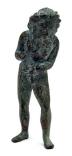
An Attractive Figural
Bronze of a Sylvan God. Roman Thrace, 2nd-3rd century AD. Perhaps a satyr,
or a woodland or river demigod, he stands, legs apart, bent over his forward
thrusting leg and holding an object now missing from his hands. The figure is
nude and slimly proportioned, but his hair and beard are richly and elaborated
curled, and expansive. As another indication of his "wild" nature, he is
depicted as hairsuit, with long locks of hair chiseled along his back and
thighs. One hand is missing, and only the remains of the object he holds is
still in the other hand -- perhaps a serpent? But for the minor losses, the
sculpture in choice condition, with thin green patina, with occasional patches
of dark red. Height: 3-1/2". A handsome and intriguing work of art.
Estimated Value $1,350-1,550.
Lot 2824

An Unusual Bust of a
Barbarian Youth, in Bronze. Roman Thrace, 2nd-3rd century AD. Hollow cast
bust, with solid head, a fitting for a chest or furniture. The youth,
unbearded, is portrayed frontal with his head barely turned to the left. His
chest is bare, but for being draped by a heavy pendant necklace. The youth's
hair is arranged into eight parallel rows of waved hair. At the back this is
bound into a thick, folded over braid, reminiscent of the earlier hairstyles of
Antonia and Agrippina. Two sizable rings for attachment at the youth's
shoulders. Piece exceptionally preserved with a choice smooth, dark green
patina. Height: 3"; Width: 3-1/4". A bold and appealing portrayal. Ethnic
depictions of this sort are surprisingly uncommon even at this time in a
hinterland where intrusions from "foreign migrants" were becoming more
insistent.
Estimated Value $1,450-1,650.
Lot 2825

A Stylish, Provincial
Roman Head of a Youth, in Bronze. Roman Thrace, 2nd-3rd century AD. Hollow
cast, the plumpish, roundly modeled head perhaps a fitting, or from a composite
sculpture. The youth unbearded, and his hair arranged as concentric rows of
locks, radiating out from the top of his head, along with a double row of tight
curls framing his temples and forehead. The pupils of his eyes pierced. At the
top of his head, a squarish hole, perhaps for attachment, or for the tenon of a
sepreately applied hat or other attribute. A smaller attchment hole at back of
neck. Intact with minimal wear, and with a mottled green, olive, and black
patina. Height: 2-1/8". Pleasing provincial work.
Estimated Value $350-450.
Lot 2826

Interesting "Mystery"
Plaque, in Lead, from the Lower Danubian Area, or Thrace. 2nd-3rd
century AD. The dominant motif of this detailed cast roundel is the large
central female figure facing, standing behind a tripod table on which rests a
fish. She wears a pleated short chiton and holds in her hands a serpent(?), or
perhaps a a length of cord. Flanking on either side in profile, two rider gods,
perhaps meant to be the Dioscuri, who each trod a fallen figure below. Above
and flanking, are facing busts of Sol and Selene (the Sun and the Moon, the
pair equating to "eternity"), and a serpent above each. In the exergue, a
Cupid(?) figure and an animal (boar?) flank a central kantharos, and beneath,
three horse shoes. The whole encircled by a border of beading and tongues.
Sharply preserved, with a thin gray and brown patina. Diameter: 2-1/4". A
fascinating glimpse here of little understood mythologies. Scarce.
Estimated Value $325-450.