
May 28, 2001, The Fairchild Family Trust Collection, Sale 10
Lot 2778
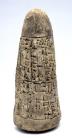

A Sumerian Dedicatory Cone
in Clay. City State of Isin, ca. 1953-1935 BC. Inscribed on a terra cotta
cone, with rounded base, is a text by King Ishme-Dagan of Isin. The Cuneiform
inscription is around the shaft of the cone, in two registers of equal length.
The text states: "Ishme-Dagan, mighty man, King of Isin, King of the Four
Quarters, when he cancelled the taxes of Nippur, the city beloved by Enlil, and
excused its men from military service, he built the wall of the city of Isin,
naming it Ishme-Dagan, the might of the great god." Complete and intact, and
finely preserved. Length: 5-3/4". Fine and scarce, with a much more interesting
text than average.
Estimated Value $1,350-1,750.
Clay cones were
inscribed with dedicatory inscriptions and imbedded in the walls of various
structures, usually temples, or, as the case here, the city's walls.
Lot 2779

An Administrative Tablet,
Cuneiform Inscribed. Southern Mesopotamia, Old Babylonian Period, c.
1900-1700 BC. BC. The tablet in a pinkish-brown clay, complete, and
written in ten lines. It lists nine men who either received, or delivered one
sheep, and their supervisor. The tablet does not denote the purpose of this
enumeration, nor is it dated, but it originates in southern Mesopotamia. Intact
and in Extremely Fine condition, the characters are written in a bold, if
somewhat provincial hand. A neat and pleasing example overall. Size: 1-3/8" x
1-3/16". Comes with full translation of text.
Estimated Value $300-375.
Lot 2780

Elaborately-handled Short
Sword. Iran, Luristan or Peripheral Caspian, c. 1000-700 BC. Sword's blade
of lanceolate shape, having thickly raised midrib and flanked by very shallow
channels servings as blood grooves -- this very typical for the blades found in
the region. The figural handle of twin lion protomes comprising the pommel, a
segmented and knobbed grip, along with stylized felines forming the hilt, is
more reminiscent of metalwork from the zone of Neo-Assyrian influence. The
handle somewhat cleaned but still with areas of pleasing green patina; the
blade left with crusty green patina. Repair at junction of blade and handle,
and trivial restoration to segment of blade's edge -- otherwise, nicely
preserved overall. Length: 18". A flashy and appealing artifact for the lover
of ancient military exotica.
Estimated Value $1,500-1,850.
Lot 2781

Jar Handle with King of
Hebron's Seal. Israel, late 8th century BC. Fragment of a large storage
jar, made of coarse gray ware, and containing the complete handle. The handle
deeply impressed by a large oval seal bearing the king's device: suggestive of
an X, a top view of an Egyptian scarab beetle displaying four wings. Above and
below, a two line inscription in paleo-Hebrew characters: "Lmlkh Hbrn"
("Belonging to the King of Hebron"). Handle well preserved, the impression
crisp and clean. The sealing remarkably complete, as it is more typical to
encounter the seal only partially impressed. Heighth: 5-3/8". An exceptional
speciman of Iron Age "Judaica." Rare.
Estimated Value $1,000-1,500.
Lot 2782

Another Jar Handle with
King of Hebron's Seal. Israel, late 8th century BC. An additional fragment,
from the same jar as the preceding lot. On this the handle partially complete,
but again deeply impressed by a large oval seal of the king's device: a top
view of an Egyptian scarab beetle displaying four wings. Above and below, a two
line inscription in paleo-Hebrew characters: "Lmlkh Hbrn" ("Belonging to the
King of Hebron"). The impression sharp and clean! Likewise the sealing
unusually complete, and much better than those usually encountered. Height: 3".
Again, a choice speciman of Iron Age "Judaica." Rare.
Estimated Value
$800-1,200.
Lot 2783
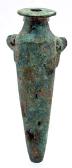
Stylish Bronze Alabastron,
from Persian Era Israel. Judaea, c. 6th - Early 5th century BC. This slim
cosmetic vessel derived from earlier Egyptian prototypes in carved stone. The
bottle with narrow conical body, the base truncated to forma small flat foot.
The neck constricted with wide everted rim -- this slightly rounded to make an
easy applicator for the oils or scented contents within (anologous to the
roll-on applicators today). Tab handles on either side, with low projecting
fins below. Within each handle, remains of links from the chain handle that was
once attached. Item intact and pristine, with pleasing medium green patina.
Height: 3-3/4", on custom plexiglass stand. Cf. Petrie, Stone Vases, for
alabastra with similar handles: no. 955 (6th century BC.); no. 959 (begining of
Persian occupation); and no. 962, for applicator top. A simple yet elegant
artifact. Scarce this nice.
Estimated Value $700-900.
Lot 2784

A Tenth Legion Floor Tile
from Ancient Jerusalem. Israel, Late 1st - 2nd century AD. The tile, a
paver, is fashioned from a gritty pinkish-biege clay and hard fired. A square
of 7" on each side, and about 1-3/8" thick, the tile has impressed on its face
a rectangular stamp with the letters "LEG X FR," for "Legio Decima Fretensis."
The letters complete and clear, although the stamp was a bit weakly impressed
at the center. The full tile nicely preserved. Decent examples are much more
difficult to find these days. An important artifact for the Judaica or miltary
collector.
Estimated Value $975-1,250.
Actually found in
Jerusalem, the owner of this and the following two lots encountered a course of
these tiles while performing some repairs and remodling to his basement. (There
must be many more interesting basements scattered around the Holy
City!).
Stationed in Palestine and Syria, the Tenth Legion made up the
forces that Vespasian employed in northern Israel during his campaignof 66 AD.
Later, the legion comprised a good portion of the troops that destroyed
Jerusalem under Titus. Three years later they completed the mopping up of the
First Revolt when they captured Masada. Afterwards, the Tenth Legion became the
official permanent garrison for the province of Judaea. Following the Bar
Kochba revolt, the legion was stationed in Jerusalem (Aelia Capitolina) itself.
In the early 1990's a major Tenth Legion site was discovered during excavations
for a parking lot next to the National Auditorium in Jerusalem. At that time a
number of like tiles came on to the market, but these have long since been
dispersed. See: N. Avigad, Discovering Jerusalem, 1980, p. 206, figs. 2, 3, and
4.
Lot 2785

Another Tenth Legion Floor
Tile from Ancient Jerusalem. Israel, Late 1st - 2nd century AD. This tile
like that in the preceding lot. A square of about 7" on each side, and 1-3/4"
thick, but this in a more tan colored clay. Impressed on its face a rectangular
stamp with the letters "LEG X FR," for "Legio Decima Fretensis." The letters
complete, although the stamping is somewhat weak or worn at the center. The
full tile nicely preserved. Again, an important collectible for the Judaica or
miltary collector.
Estimated Value $675-950.
Lot 2786

A last Tenth Legion Floor
Tile from Ancient Jerusalem. Israel, Late 1st - 2nd century AD. A good
sized fragment of the tiles seen in the preceding lots. A roughly triangular
piece of about 5" on the longest sides, and 1-1/4" thick. This tile in a
red-orange clay. Impressed on its face a rectangular stamp with the letters
"LEG X FR," for "Legio Decima Fretensis," the letters are three quarters
complete, and fully legible. A bargain example of this historic artifact.
Estimated Value $400-475.
Lot 2787

Important Judaic Ceramic
Lamp with Menorah Motifs. Arab-Byzantine Era Palestine, c. 7th-9th century.
So-called "slipper" lamp, for its shape, is molded in two pieces in a
red-orange terra cotta. The underside of the lamp plain, the shoulders
ornamented, a plain trough-like channel connects the wick and filling holes. As
typical of this class, the decorative motifs are symmetrically placed: towards
the nozzel, a long palm branch; at the knob handle a small tree or branch.
Flanking these on either side are two menorahs, plus rectangular grids,
suggesting walls or panels. The lamp virtually pristine, with thin, cleanable
calcerous patina. Length: 3-1/2". Rare and noteworthy.
Estimated Value
$1,500-UP.
Usually in this class of lamps, menorah-like motifs are found
but are very crude, and can with equal likelihood depict tree or floral
subjects, rather than the menorahs as some attest them to be. On the above
lamp, however, the menorahs are clear and explicit. In fact, two varieties are
shown. One, the normal type with six arms flanking the central arm, is as
expected. However, the second, without a doubt shows eight arms and is thus a
Hannukah lamp! Taken overall, the motifs around the lamp's shoulders can be
considered an emblematic representation of a synagogue or temple. And so, an
important object of early Judaica.