
May 28, 2001, The Fairchild Family Trust Collection, Sale 10
Lot 2788


A Fine Faience Bead, with
Twin Eyes of Horus. Egypt, Third Intermediate Period, 1075-664 BC. The bead
barrel-shaped, well molded, with an excellent, richly colored turquoise blue
glaze. The design is replicated on each half of the bead, with one being the
mirror image of the other. Each side with an udjat, the Sacred Eye of
the Egyptian god, Horus. The brows and pupils with added black glaze. Dividing
the the two eyes, a pair of leaf shapes with herringbone pattern. But for
trivial edge chip, the bead intact and choice, the glaze fine and glossy.
Lenghth: 1-1/4". Excellent example of the type, which is scarce, and even more
so in this condition. In the marketplace, over the past decade, prices on
boldly colored faience amulets and objects have been rising steadily. Added to
this is the market for exotic and unusual beads by a growing collector base.
Desirable! .
Estimated Value $800-1,000.
Lot 2789
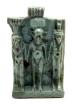
Good-sized Amulet of
Horus, Isis, and Nepthys. Egypt, Late Dynastic, c. 550-350 BC. The young
Horus stands frontal, flanked by and holding hands with his mother, Isis, and
aunt, Nepthys. Each goddes in long dress, with lappet wig, and each wearing a
different symbolic headdress. Horus with solar disc above his head. They stand
on rectangular base, against rectangular backing. Grooved loop at top for
suspension. The faience amulet repaired across legs, with minor restoration at
lower left corner. The green to slightly olive-tinged glaze glossy and
beautifully preserved. Height: 1-7/8". Boldly detailed, and larger than usually
encountered for this type of amulet.
Estimated Value $600-725.
Lot 2790
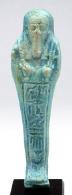
Colorfully Glazed Faience
Ushabti. Egypt, Late Dynastic, c. 450-350 BC. Probably XXXth Dynasty.
Ushabti of mummiform shape, standing with arms crossed, holding adze and hoe.
Figure with lappet wig, beard on chin, and swathed in Osirid-like garments.
Ushabti with inscriptions in panel runnining vertically down the front of the
legs. The artifact in choice condition, the colorful turquoise to blue-green
glaze very pleasing. Height: 4-1/4"; mounted on black-colored base. A pleasing
example of this popular Egyptian antiquity.
Estimated Value $525-675.
Lot 2791
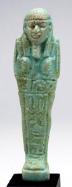
Another Colorfully Glazed
Faience Ushabti. Egypt, Late Dynastic, c. 450-350 BC. XXxth Dynasty.
Ushabti of mummiform shape, standing with arms crossed, holding adze and hoe,
plus a seed bag thrown over one shoulder. Figure with lappet wig, beard on
chin, and swathed in Osirid-like garments. Ushabti with two lines of
inscriptions, in two panels: one across, horizantally, underneath the arms, the
second runnining vertically down the front of the legs. The artifact in choice
condition, the colorful turquoise glaze even and attractive. Height: 4-1/4";
mounted on black-colored base. A excellent example of this popular Egyptian
antiquity, with bold, sharply modelled facial details.
Estimated Value
$550-675.
Lot 2792

Sizeable Hieratic Text, on
Linen, from a Mummy's Wrapping. Egypt, Late Dynastic - Ptolemaic
Period, c. 500-100 BC. On a strip of somewhat coarsely woven linen,
running along its length two parallel lines of hieratic script are inked in.
Hieratic was simplified, one can almost say a shorthand, version of the
Egyptian hieroglyphs developed by the scribes to enable their pictographic form
of writing to be jotted down with a speed not possible earlier. Done by a neat
hand, the text is quite legible, even stylish. Said to have been among a
mummy's wrappings, the now brown linen with a few modest stains and one hole in
a portion of the cloth. Overall, however, the linen well preserved and the text
extremely clear. Length: 41". A notable artifact, and choice. Such extensive
texts rarely appear on the market these days, and this is an opportunity that
shouldn't be missed.
Estimated Value $1,750-UP.
Lot 2793
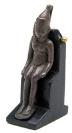
A Rare Silver Amulet of
Harpocrates. Egypt, Late Period-Ptolemaic, c. 650-300 BC. The child Horus,
son of Osiris and Isis, is represented in tradional Egyptian fashion -- nude
and with arms held rigidly at side. His head is shorn, but for a child's
sidelock of hair. He also wears the royal crown of Upper and Lower Egypt, plus
a beaded broad collar. A small rectangular base contains his feet. Grooved loop
at back for suspension. Intact, with only light wear, the details clear and
wholly legible. With deep gray-brown "find" patina. Height: 1-7/8"; in old
black lacquered wood mount. Although small, the object fully retains the
monumental feeling of much larger Egyptian works. Choice and rare -- quality
survivals of amulets in silver is actually rarer than that for gold.
Estimated Value $2,500-3,500.
The traditional features, constently
realized on the piece, along with the absense of any foreign or classicizing
elements, strongly suggests an earlier date for the amulet, rather than later
-- perhaps even XXVI Dynasty.
Lot 2794
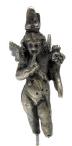
A Rare and Fine
Pantheistic Harpocrates Amulet in Silver. Late Helleistic Egypt, 1st century
BC. Greco-Roman Egypt, Late 1st century BC. - 1st century AD. The
child aspect of the Egyptian god, Horus, merged with that of Eros/Cupid. The
figure modeled along the lines of the Hellenistic erote, with the child's
figure plump and rounded, almost feminine in appearance. As per Egyptian
traditions, the god holds his finger to his mouth to indicate his youthfulness,
and wears the royal double crown. Aside from Cupid's attribute of the
arrow-filled quiver, the god holds the cornucopia of Tyche, and wears the
panther skin of Dionysus. The figure finely modeled and detailed, with
suspension loop at back. Aside from losses to the feet and the tips of the
wings, the silver nicely preserved for finds from this area. Height: 1-1/2";
mounted on stand. Rare! .
Estimated Value $2,500-3,500.
Harpokrates,
the child of Isis and Osiris, was often conflated with the Greek Eros (or Roman
Cupid) during this period as a harbinger as abundance. In this example, that
concept is further reinforced by the cornucopia of Tyche. The attribute of
Dionysus added further spiritual nauances to those already covered by the three
other deities.
Lot 2795
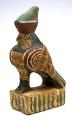
A Boldly Colored Carving
of Horus as a Falcon. Roman Egypt, 2nd-4th century AD. Carved in the round
in wood, and then gessoed and painted, the god stands on a rectangular base.
The bird of traditional form, facing front, wings tight against the body, and
wearing the crowns of Upper and Lower Egypt. The bird's anatomical details
rendered as raised stylized patterns, and richly colored: its head feathers and
feet painted in black, the crown in green and dark red, tail in green, and the
wings and body in browns, dark reds, and ochres. The base motifs in dark red
and green. Exceptionally preserved, with only minor touch-up or restoration.
Height: 8-7/8". A colorful and desirable objet d'art.
Estimated Value
$3,500-UP.