
May 28, 2001, The Fairchild Family Trust Collection, Sale 10
Lot 2796


Large and Impressive
"Spectacle" Fibula. Celtic Eastern Europe, c. 8th century BC. Simply, yet
ingeniously contrived from one length of copper or bronze heavy wire that has
been wound to form the face plate, catch, and pin of a large garment fastener.
The "spectacle" is comprised of two spiral discs, one forming the base of the
pin and the other the base for the catch, and joined by a figure eight loop.
Intact and perfect, with very good original green "find" patina, with some
slight iron deposits. Width: 8-1/4". A choice and elegant object, exemplifying
how 'modern' looking an antiquity can sometimes be. Rare for the pin being in
perfect working order, as they are frequently missing, repaired, or
fragmentary.
Estimated Value $1,400-1,800.
Similar fibulae have been
found in all parts of the Greek world, and along the peripheries. The material
has been discussed in J. Alexander, "The Spectacle Fibulae of Southern Europe,"
AJA, Vol 69, 1965, p. 5ff.
Lot 2797

A Greek Protome bust of a
Goddess, Archaic Period. Sicily, late 6th century BC. A female head from a
votive bust or revetment. The fragment is molded in a moderately fine-grained
micaceous clay of orange-tan color. She is veiled, with sharply angled
almond-shaped eyes enlivening her plumpish face. A hole at the top of her head
is provided for nailing to a surface. Head with moderate wear. Height: 6-1/8".
A pleasant and affordable Greek sculpture of good size. Her sweet, archaic
smile eye-catching.
Estimated Value $475-600.
Lot 2798
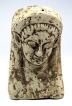
Another Greek Protome Bust
of a Goddess of the Archaic Period. Sicily, end 6th - early 5th century B.
A female bust, the head turned slightly down, is molded in a moderately
fine-grained micaceous clay of creme-tan color. She is veiled, with a fringe of
tightly curled ringlets framing her plumpish face. There is a hole at the top
of her head for nailing to a surface. A spall in the clay at her neck,
otherwise piece intact with moderate wear, and some easily cleanable dirt.
Height: 6-5/8". An affordable Greek sculpture of decent size and quality.
Estimated Value $650-750.
Lot 2799

A Rare and Important Group
of Greek Gilded Silver Roundels. Greece, possibly Macedon, Mid-4th -
Early 3rd century BC. Lot of five roundels, circular and shield-like in
appearance, with raised convex faces, encircled by a recessed flange. The
roundels each with a single ornamental device, worked en repoussè and
chased. Four have variations on a six point star -- each with central round
boss, and the rays ranging from thin, to thick rays, and ribbed rays to
petal-like rays. The last roundel with a combination of four ribbed rays, of
cruciform shape, atop a rose of four petals. On the reverses, two narrow bands
of hammered silver sheet are crossed and riveted to the edges to allow the
pieces to be slipped onto a belt or strap. Three pieces have these complete,
but missing on the "rose" example, and one of the stars shows a loss of one of
the bands. Roundels overall Very Fine, or better, with most of the gilding
complete. The "rose" a little chipped and bent, with more of the silver
visible. Average Diameter: 3". Important and rare! A very affordable group of
historical Greek silver.
Estimated Value $1,750-UP.
These pieces may
be compared to the metalwork discovered in the royal tomb at Vergina, Macedon.
and thought to be that of Philip II, father of Alexander the Great. The
frequent appearance on artifacts retrieved from the excavations would seem to
indicate that this type of star may have been a royal ensign.
It was said
that these pieces were part of the accoutrements on a soldier's armament. They
could well work as such, but more likely these were ornaments to a horse's
trappings. But as an aside to that possibilty, ownership and maintenance of a
horse by a soldier in ancient Greece would also indicate that the person was
one of some affluence and social status. This, along with the possible
cachè of "royal" because of the motif on the pieces, can suggest that
the owner of these was attached to the guard or calvery of one of the kings of
Macedon.
Lot 2800

A Splendid Sheep's Head
Rhyton. Magna Graecia, Apulia, c. 350-320 BC. The drinking vessel shaped
with trumpet-like neck and rim, flattened strap handle, and the bottom
naturalistically modeled as a sheep's head. Rhyton potted from a fine grained
pinkish-tan ware, and glazed with a tan-orange slip. Minor chipping to the tips
of the hanimal's horns, otherwise intact and exceptionally preserved. Length:
7-1/4". A delightful work of art.
Estimated Value $3,250-4,250.
Apulian rhyta in the form of aniaml heads -- deer, bulls, rams, sheep,
and goats, etc., were produced in both the elaborate red figure manner, or with
simpler undecorated slips, such as the above vessel. Some were true rhyta, with
a hole in the animal's mouth for the passage of wine. Others, as seen here,
lack a pouring hole. For other plain-glazed sheep's head rhyta, cf. H.
Hoffmann, Tarentine Rhyta, Mainz 1966, pls. XXI, 1; LV, 4, & 7.
Lot 2801
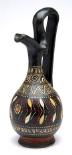
Colorful and Detailed
Gnathian Epichysis. Magna Graecia, Apulia, c. 330 BC. This class of bottle
or juglet bears the consistant traits of a narrow neck, a thin beak-like spout,
and high strap handle. Potted from a fine grained pinkish ware, it is covered
with a slightly silvery, black glaze, with applied designs on the body in red,
white, and yellow. The ornament in three bands: a stylized laurel wreath with
central rosette; a band of chevron-filled zigzags; and a band of floral
scrolls. These bordered top and bottom with bands of tongues. At the juncture
of handle and spout are molded two small female masks. Slight repairs to handle
and spout, otherwise bottle intact and pristine. Height: 7-1/8". A lovely
example of this class of ornate bottle.
Estimated Value $950-1,250.
Lot 2802

Stemless Kylix with
Portait of Athena. Magna Graecia, probably Campania, later 4th century BC.
The kylix, a shallow cup for drinking wine, of usual shape but for short
ring foot on bottom. The whole with black glaxe but for reserved area with
bottom of foot and red figure tondo within cup. The tondo painted with profile
left portait of Athena. She wears crested Attic helmet, with upraised plume at
side, a necklace and patterned collar, and holds before her the head of a
lance. As is typical, piece recomposed from large fragments, with minimal
restoration and is in excellent condition overall. Maximum width: 7-3/4". An
unusual compostion. Rare.
Estimated Value $2,250-2,750.
Lot 2803

A Splendid Eros in Terra
Cotta. Magna Graecia, probably Tarentum, 3rd-2nd century BC. The figure of
the youthful god of love (and lust), is both artful and dynamic. Comprised of
both molded and hand modeled components, he flies forward, his head cocked to
one side, his hand out and holding a now missing object. His legs are set as if
he is striding along with an insouscient air. Emphasizing his pose, the cloak
draped about him is an orchestration of folds and swirls. Fashioned from a deep
red-brown clay, the figure retains much of the white slip, and a bit of the red
paint that decorated him. An old collection number can be seen inked in on the
back. Height: 4-7/8". Some modest repairs and restoration, mainly at the wings.
Otherwise, the figure in choice condition -- the crispness of the molded and
modelled face, along with the hand tooled hair, all retain their vivacity after
more than two millennia! Very appealing Hellenistic art.
Estimated Value
$1,250-UP.