
May 28, 2001, The Fairchild Family Trust Collection, Sale 10
Lot 2804


Superbly Patinated Bronze
of a Youthful Herakles. Etruscan or Italiote, late 5th-4th century BC.
Herakles modeled as a youth, nude, with hair in relatively short ringlets
and lacking a beard. Overall the figure is slim, the musculature on the torso
soft and rounded, and sensitively modeled. He holds an object in his left hand,
likely a snake (fragmentary) which he is about to club (missing) with his
raised right hand. Draped over his left arm, the pelt of the Nemean lion. Left
foot also absent, otherwise bronze splendidly preserved with a marvelous green
patina. Comes with custom plexiglass stand. Height: 4-1/8". Cf. Adam,
Bronzes Etrusques et Itailques (Bibliothèque Nationale), p. 184, no.
279. A fine example of this subject which was particularly popular with the
Etruscans.
Estimated Value $1,850-UP.
Lot 2805

A Superb Balsamarium or
Cosmetic Pot in Bronze, in the form of a Comedic Mask. Greco-Roman, 1st
century BC - 1st century AD. The small vessel, roughly globular, is modeled
in the round as the mask of a cunning and manipulative slave, a character made
popular in the bawdy Athenian "New Comedies." The face very expressive, with
glaring eyes, furrowed brows, short nose and wide gaping mouth. The mask's wig
full and rounded, the hair depicted as tightly matted. Twined around the head a
sinuous wreath of grapes and vines. The rim of the vessel with "dog tooth"
edging, slightly turned out. There is a very small projecting foot at the
bottom. This along with the two ribbons from the wreath form a shallow tripod
base to the pot. Balsumarium choicely preserved, with very pleasing deep green
and black patina. Something different -- a bronze with an attitude and a look!
.
Estimated Value $1,850-UP.
Lot 2806

A Masterful Bronze
Statuette of Jupiter. Roman, 1st-2nd century AD. The god stands with left
leg slightly flexed, his weight on the right, with torso slightly twisted and
head partially turned to the side. The cloak draped long his left side further
emphasizes the Praxiliteian s-curve to his pose. His figure is robust and
mature, the muscles on the torso strongly defined, and his beard long and full.
His accoutrements include the large-leafed wreath on his head, and the
thunderbolt (fulmen) in his right hand. The raised left hand once held a
scepter, now missing. Left foot also missing, otherwise sculpture in choice
condition, with fine, glossy olive and light green patina. Height: 3-3/4"; with
custom stand. A quality work of art! .
Estimated Value $3,000-5,000.
This statuette of Jupiter may ultimately be based on a Greek cult statue
of Zeus from the 5th century BC. For other bronzes of this type, cf. LIMC VIII,
430-31, pls. 252, nos. 274, 275.
Lot 2807

Impressively Sculpted
Appliqué of a Ram's Head, in Bronze. 1st-2nd century AD. The
appliqué, probably from a vessel or cauldron, boldly and
naturalistically modeled. The ram with expressive eyes and richly curling mane,
is displayed frontally and in high relief -- to the point where it could have
functioned as a handle. Intact and in choice condition, with excellent deep
emerald patina, with touches of black. Height: 2-3/8". Outstanding Roman art! .
Estimated Value $1,450-1,850.
Lot 2808
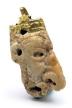
An Interesting
Pendant/Charm of Grotesque Head. Roman, 1st-2nd century AD. Carved from a
narrow, slightly curved piece of creme-tan limestone or calcite, the pendant
caricatures a man's profile. The head small and bald, the eyes squinty and
frowning, the bony jaw with a twisted and sniveling mouth. All this, plus the
dominating prow of a nose. The top of the head pierced to hold a gold cap and
loop. The nose and ear also pierced, and which may have held further pendants
or dangling rings. Limestone shows moderate wear to the highpoints, but overall
the pendant is well preserved. Height: 1-1/4". A fascinating and unusual
miniature. Said to have been found in Egypt.
Estimated Value $1,500-2,000.
The grotesque, an extremely popular theme among cosmopolitan
Alexandrians, was thought to be an effective charm against the evil eye.
Lot 2809

A Roman Inscribed Funerary
Plaque, in Marble. AD. Roman Western Europe, 4th-5th century AD. The
smallish plaque carved from creme marble with gray veining. A three line
inscription, in Latin, occupies the upper third of the stone: TINIA C F
PRISCA / COMMVNIS / EXOCHE". "(here is buried) Titinia Prisca, daughter of
G(aius), together with Exoche(?)." Size: 7-3/4" x 14-1/2"; set into custom
frame. A simple but pleasing artifact. From an English collection. Scarce.
Estimated Value $3,000-4,000.
The size of this plaque suggests that
it was an employed in a columbarium, an above ground crypt-like burial system
which took its name from its resemblance to dovecotes.
Lot 2810

A Lengthily Inscribed
Funerary Plaque, in Marble. AD. Roman Asia Minor, 4th-5th century AD. The
plaque carved from a block of quality white-creme marble of moderately large
grain. It is entirely covered by a neatly carved seven line inscription in
Greek, stating: "Tomb of the blessed and great Doxasia, daughter of Dora, these
resting bones in soul, and in god and the mystery of death, and in the hour of
judgement, that no one will remove from here, neither the remnents, nor would
he separate the bones from me." From a very sheltered monument, as the marble
shows only modest weathering. Overall, crisp and easily readable. Size: 11-1/4"
x 17-7/8"; with custom base. A quality artifact for those collectors of
inscribed works. From an Israeli collection. Scarce.
Estimated Value
$4,000-6,000.
Although there is no explicit reference to Christianity,
the deceased or her family clearly believed in an afterlife and a final
judgement. Thus, they would have been participants in a monotheistic mystery
religion. Also of note is the absence of a father's name in the inscription. It
would appear that the mother, whether widowed or single, would have to have
been a woman of some substance and status to afford such a tombstone for her
daughter.
Lot 2811

A Fine Erotic Roman Lamp.
Roman Italy, 1st century AD. The lamp of discus type, without handle, but
with elongated nozzel flanked by volutes. Within the large circular discus, a
scene of a man and a woman engaged in sensual delights -- the man grasps her
foot and raises her leg high. Also clearly indicated is the bed: with patterned
bedding, a bolster-like pillow, and elaborately turned legs on the bed frame.
On the base of the lamp is slightly raised maker's mark, looking like a
ligature of a P and a C. Lamp intact and shows some moderate wear to the
orange-brown glaze, mostly at the nozzel. The molded design is bold and the art
quite good. Length: 4-1/4". For this motif, cf. BMC, Lamps, Q922. A very
fine example, and absolutely genuine! .
Estimated Value $600-750.
Lot 2812

Another Quality Erotic
Roman Lamp. Roman Tunisia, 1st-2nd century AD. This lamp also of discus
type, but with grooved ring handle, and short ovate nozzel. The scene here a
variant on the preceding lamp. The man and the woman share close eye to eye
contact, as he is about slip between her legs. The bed also different here --
more like a low divan, with raised board at the head, and very short turned
legs. Base of the lamp is impressed with uncertain maker's mark. Lamp intact
and nearly pristine, with only minor weathering to the red and brown slip. The
art large and good, if a bit softly molded. Length: 4-3/8". Again, another fine
example.
Estimated Value $650-750.
Lot 2813
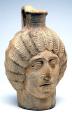
A Fine Early Severan Head
Vase. North Africa, c. 200 AD. Molded in two halves, this thick-walled,
robust vessel is fashioned from a moderately coarse buff ware, and covered with
a creme-orange slip. Vase with short oval neck and spout, and single strap
handle at back. Molded in the form of a woman's head, her features bold
treated, but the detailing careful -- especially notable in the finely rendered
hairdo. The hair arranged in the then contemporary fashion of rather tightly
curled waves over the top and sides, and flattish, layered bun at the back.
This is precisely the hairdo seen on the coins of Julia Domna up to around 210
AD. Considering the profile of the face seen on the vessel, and the shape of
the nose, her portrait is likely intended here. Minor repair to handle,
otherwise vase intact and finely preserved. Height: 8-3/8". Scarce, and choice.
Estimated Value $1,800-2,200.
Lot 2814
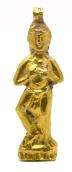
Gold Fertility Figure of
Venus/Astarte. Roman Near East, 2nd-4th century AD. The gold pendant
comprised of two sheets of gold, and integral loop. Joined together by folding
the front's edges over the back, it is strengthend by a hard filling substance
within -- to give the piece solidity without adding extra gold weight. The
figure that of Venus/Astarte, a Hellenized form of the Near East's most ancient
goddess of love and fertility. The goddess stands frontal on a short dais.
Clasping her breasts and raising one leg slightly to display her enlarged and
boldly delineated pudenda, she stands naked but for a belt or girdle, with
distinctive knot at center, which encircles her waist. Intact and pristine.
Height: 2-1/2". Rare! Large, lightweight gold amulets, such as this, rarely
survive from antiquity. If, on the one hand, they were not crushed or damaged
from the weight of compressing earth over the centuries, then random finders
would usually quickly reduce them to melted gold, a form more suitable to their
modern day needs.
Estimated Value $2,500-3,500.
Lot 2815

Lot of Two Fine Figural
Fragments from Roman Red Ware Trays. North African, 4th-5th century AD.
Probably from Carthage. Lot of two pieces from different serving trays of
rectangular shape, with molded decorations on the raised, pedastle-like base .
The largest fragment, of three recomposed pieces, shows a procession of three
men and three woman, all in ornate fringed and paterned garments. One female
holds a patera, while a man and a woman holds an item of fish-like shape (a
basket?). At either end, partial figures of a flute player and one holding a
helmet. Along with the molded designs, impressed rosettes in the field. The
second piece, smaller, and with raised, molded design only. This with an
intriguing scene. Within a rectangular section bordered by pillars, a woman(?)
in chiton and bound hair, kneels left, one hand tipping a balance, a
wide-mouthed vessel below. At left, a bearded man, wearing cap and short tunic,
sits three quarters to the right on elaborate chair and regards her. He has
sheathed sword resting on lap; horse protome above his shoulder. Beneath
balance, raised inscription in Greek: KIRKE, "Circe." This perhaps a scene of
Ullyses' encounter with the sorceress? Fragments well preserved and of much
more interest than typically encountered. Lengths: 8-1/2"; 4-1/2". Scarce this
nice; the latter motif rare.
Estimated Value $400-500.
Lot 2816

Another Group of Fine
Figural Fragments from Roman Red Ware Vessels. North African, 5th century.
Probably from Carthage. Lot of four pieces, all but one with mythological
motifs. Two pieces, again, from a large rectangular serving dish: one showing a
draped and veiled woman leading a naked young child up to a centaur to the
right, who holds a staff, and has one hand raised; the second with perhaps a
satyr, in heavily patterned short tunic, and playing a large pan-pipes to the
goat-footed Pan, who dances at the left. Also, a rim from a large tray: a male
figure in long tunic holds cup(?) and cross-like object (thyrsus?), with short
column, topped by ornate capital, occupying the corner. Last, a section of bowl
with molded and applied fish. All well preserved, with strong, legible designs.
Widths: 2-1/4" - 3-1/4". Lot of 4 pieces. Good dealer lot.
Estimated Value
$400-475.
Lot 2817

A Fine Christian Lamp from
Carthage. North Africa, 5th century AD. Molded in a red-glazed red ware,
the lamp with circular body and extended trough-like nozzel. Centered within
the sunk central discus, a large Chi-Rho, the sacred monogram, with ornate
interior patterning. Similar decoration comprised of alternating Chi-Rho
roundels and patterned squares border the emblem along the lamp's shoulders.
Lamp with tab handle, and slightly raised circular foot underneath. Slight chip
to the handle, the nozzel a bit soot-stained from use. Otherwise the lamp in
choice condition, with the designs crisply molded. Length: 5-1/2". For another
related example, cf. A. Ennabli, Lampes Chrétiennes de Tunisie,
no. 1042, but Chi-Rho retrograde. Choice! .
Estimated Value $375-475.
Lot 2818

A Lot of Seven Medical or
Medicinal, or Cosmetic Implements in Bronze. Roman, 2nd-5th century AD. The
group comprises a varied assortment of shapes. One certainly a cosmetic
applicator -- long and simple, with ovate-shaped end at one side, the other end
decorated with circular ribbed ornament. In addition there are four spoons with
probe/applicator ends. The spoon's bowls each of different size or shape, along
with three having molded decoration on the handle. Another item has a rather
arrowhead-like end that may have been a form of lancet or scalpel -- if so,
unused, as the blade has not been sharpened. The last an applicator/spatula,
the blade end ornately shaped. All well preserved, with varying brown or green
patinas. Lengths: 4-3/4" - 6-3/4". An pleasing assortment.
Estimated Value
$650-850.
Lot 2819

A Lot of Six Medical or
Medicinal Implements in Bronze. Roman, 2nd-5th century AD. Group comprises
a varied assortment of shapes and types. Two are probes or applicators -- one
long and simple, with each with ovate-shaped end a different size; the other
shorter and symmetrical, with central "handle" of geometric mouldings. Two more
probe/applicators, but the rounded and rectangular ends could likewise have
served as spatulas. Another item is short, one end of olivary form, the other
rather arrowhead-like (slightly chipped) that may have been a form of lancet.
The last piece a simple form of scalpel. All well preserved, with varying brown
or green patinas. Lengths: 3-3/8" - 7-3/4". An interesing general assortment.
Estimated Value $650-800.
Lot 2820

Another Lot of Seven
Medical or Medicinal, or Cosmetic Implements in Bronze. Roman to
Byzantine, 2nd-10th century AD. The group mostly larger pieces and some
unusual shapes. Included are three spoons of different dates. The spoon's bowls
each of different size or shape, along with two having molded decoration on the
handle, and the largest and latest with arabesque-like decoration on the
exterior. Another item seems to be a form of scoop, with narrow, elongated
bowl. Also an applicator/spatula, the blade end narrow; and another "spatula"
with circular blade. Lastly, a scalpel, the blade thin from use, with twisted
"grip" at base of blade. All well preserved, with varying brown or green
patinas. Lengths: 4-1/4" - 6-1/2". An interesting assortment of better items.
Estimated Value $700-850.